Unfixed Road Levels: A Hidden Urban Design Challenge in Bangladesh
Overview
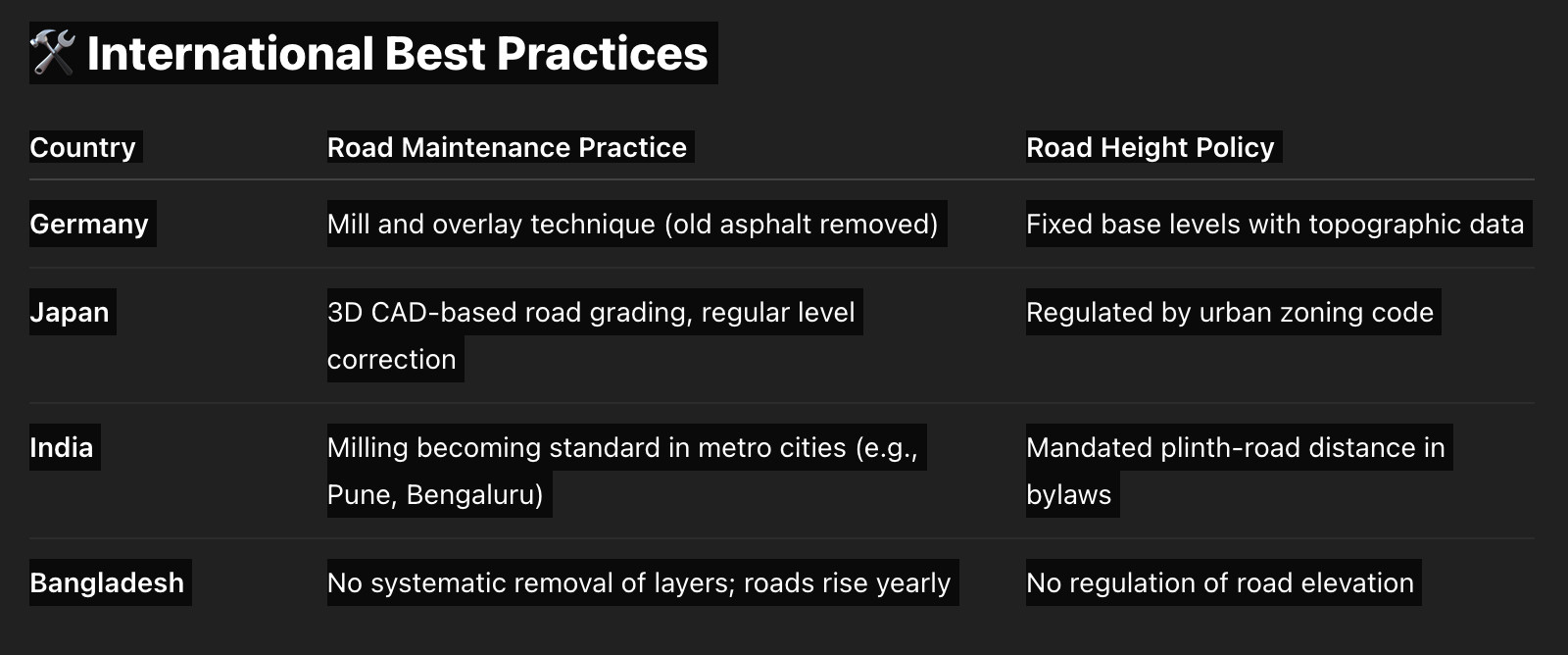
"In Bangladesh, there's no system in place to maintain road heights at a fixed level. Consequently, it's believed that each year when roads are improved, new layers of asphalt are simply added on top of the existing ones. This causes the roads to continuously rise. Due to this concern, buildings adjacent to the roads often have plinth heights that are higher than necessary, in anticipation of future road elevation. The goal is to ensure the buildings never become lower than the road level. This issue could be resolved if road levels were maintained at a fixed elevation. During road improvement projects, the old asphalt could be removed before applying a new layer, similar to practices in other countries. This would allow building plinth heights, sidewalks, and access roads to all be maintained at a consistent, predetermined level."
One of the lesser-discussed but deeply impactful urban design issues in Bangladesh is the continuous rise of road levels over time due to poor road maintenance practices. Instead of milling (removing) old asphalt before repaving, new layers are repeatedly added over the old surface, causing a gradual elevation of roads year after year. This directly affects building design, drainage, pedestrian access, and urban aesthetics.
Key Feature: Unfixed and Rising Road Levels
Core Problem:
- Roads are not resurfaced by removing the old layers.
- Instead, new asphalt layers are simply added over the existing ones.
- Over decades, this has raised roads by several feet above their original grade.
Impacts on Building Design
1. High Plinth Construction
- Buildings near main roads are constructed with unnecessarily high plinth levels.
- Owners anticipate future road elevation and raise floor levels to prevent water intrusion.
- This leads to:
- Uncomfortable access (steep stairs).
- Inaccessible entries for elderly/disabled.
- Disjointed connection between sidewalks and entrances.
Survey Insight (Dhaka, 2022):
- In a sample of 300 buildings along Mirpur Road and Dhanmondi:
- 72% had plinth levels over 3 feet higher than the existing road level.
- 56% were constructed based on speculative future road height projections.
Waterlogging and Drainage Failures
2. Blocked Drainage Channels
- Raised roads bury roadside drains and reduce drainage slope.
- Water from houses flows toward the roads instead of away, reversing natural drainage.
- Flooding increases during monsoon, particularly in:
- Old Dhaka
- Rampura-Badda
- Agrabad, Chattogram
Data (WASA 2023):
- 40% of storm drains in Dhaka are reported to be non-functional due to elevation mismatch with rising roads.
Accessibility and Walkability
3. Mismatched Sidewalk Levels
- Sidewalks get buried or misaligned due to road elevation, leading to:
- Tripping hazards
- Water pooling on pedestrian paths
- Inconsistent connections to shops and homes
4. Impact on Disabled and Elderly Access
- High building entries + uneven footpaths create barriers for wheelchairs, strollers, and the elderly.
- Violates Universal Design principles and UNCRPD accessibility standards.
International Best Practices
Case Example: Green Road, Dhaka
- 2002: Road elevation = baseline (0 feet)
- 2024: Road elevation has increased by approx. 2.5 feet
- Consequence:
- Adjacent shops now sit below the road, causing water seepage during rainfall.
- WASA drainage lines are blocked or rendered ineffective.
Design and Economic Consequences
- Costly Construction: Elevated plinths require more materials, deeper foundations.
- Aesthetic Disruption: Varied levels lead to disjointed urban visuals.
- Repeated Retrofitting: Buildings need to retrofit access ramps or rebuild entries.
Root Causes
- Lack of technical specification in LGED/RHD road contracts.
- Absence of municipal coordination between road construction and building authorities (RAJUK, City Corporations).
- Budget misuse: Easier and cheaper to lay asphalt than remove and regrade.
Recommendations
Short-Term:
- Mandate Milling of Roads before overlay in all road improvement contracts.
- Survey and GIS Mapping of current road and building levels.
Medium-Term:
- Standardized Elevation Guidelines for urban roads and building plinths.
- Reintroduce slope-corrected drainage systems in coordination with WASA/DCC/RAJUK.
Long-Term:
- Urban Road Elevation Database: Use LiDAR and GIS for city-wide height mapping.
- Amend Building Codes to align with fixed road elevation policies.
Conclusion
The issue of rising road levels is not merely cosmetic—it has profound implications for building design, accessibility, waterlogging, and urban sustainability. By adopting proper road milling practices and fixed elevation policies, Bangladeshi cities can reclaim functional, inclusive, and resilient streetscapes.